
Overview
‘Senza dubbio le riflessioni e le osservazioni contenute nel volume, unite al fondamentale strumento costituito dalla banca dati, risultano di grande stimolo per affrontare ed approfondire un tema che, dati alla mano, come dimostrato in questo lavoro capitolo per capitolo, ha ancora molto da suggerirci e rivelarci sulla società romana. In definitiva, questo libro rappresenta una risorsa preziosa per chiunque desideri affrontare il tema della rappresentazione degli strumenti di scrittura romani sui rilievi epigrafici, offrendo un’analisi dettagliata e rigorosa e gettando nuova luce su un aspetto della cultura materiale romana cruciale e ancora ricco di interrogativi.’ [translated: Without a doubt, the reflections and observations contained in the volume, combined with the fundamental tool constituted by the database, are a great stimulus to address and explore a topic which … still has much to suggest and reveal to us about Roman society. Ultimately, this book represents a valuable resource for anyone wishing to address the topic of the representation of Roman writing instruments on epigraphic reliefs, offering a detailed and rigorous analysis and shedding new light on an aspect of Roman material culture that is crucial and still full of questions.] – Donato Fasolini (2024): Cuadernos de Filología Clásica. Estudios Latinos
‘The overall value of this volume is its ability to call attention to a phenomenon that has sometimes been taken for granted in previous scholarship, but about which firm answers still elude us. … This book certainly fills a gap in the scholarship, but more than that, it demonstrates how much more work remains to be done on this and related topics. The lack of firm conclusions throughout the book supports this observation. … In order to fully understand how the various writing implements discussed in this volume functioned on funerary monuments, we must understand better how they functioned in real life. From there, the many messages that were being sent and the gestures that accompany the messages can be better understood. This volume and its associated projects are a wonderful starting point, and I hope that the participants will continue exploring this interesting line of research.’ - Elizabeth C. Robinson (2025): Bryn Mawr Classical Review
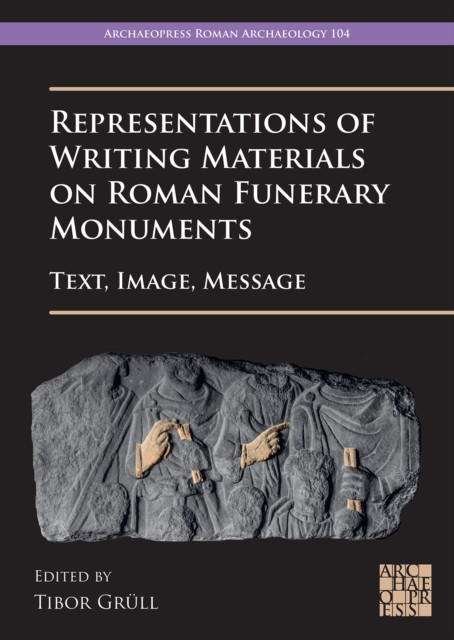
Ancient funerary reliefs are full of representations of writing materials and instruments, the interpretation of which can help us better understand the phenomenon of ancient literacy. The eight studies in this volume were delivered as lectures at an online conference organized by the Department of Ancient History at the University of Pécs in October 2021. The comprehensive introductory study (N. Agócs, T. Grüll, J. Jusztinger, E. Szabó) is followed by two thematic studies on depictions of the Muses (E. A. Meyer) and the role of women in written culture (J. Luginbühl). Two studies address writing materials: the well-known and widespread writing tablets (B. Hartmann), and the less-known bone spatulae which nevertheless also occur frequently (A. Willi). Finally, three studies deal with depictions of writing instruments and materials in certain regions of the Roman Empire: at Palmyra (Ł. Sokołowski), in the two Moesiae (S. Pilipović) and in Phrygia (T. Grüll). Each of the studies enriches our knowledge of Roman writing with many new aspects and many detailed observations.
- | Author: Tibor Grull
- | Publisher: Archaeopress
- | Publication Date: Oct 27, 2023
- | Number of Pages:
- | Language:
- | Binding: Paperback / softback
- | ISBN-13: 9781803275666
- | ISBN-10: 1803275669